The Garmin IMG Format — Architecture and Operation
This page provides a pedagogical explanation of the internal architecture of the Garmin IMG format — the binary format in which all Garmin maps are stored. It is based on public specifications (imgformat-0.5 by John Mechalas, 2005), mkgmap r4924 sources, the imgdecode-1.1 decompiler, and imgforge source code.
Overview
A Garmin .img file is not an image in the usual sense. It is a miniature file system — similar to a DOS floppy disk — that contains several sub-files encoded in little-endian. Each plays a precise role in rendering, routing or metadata.
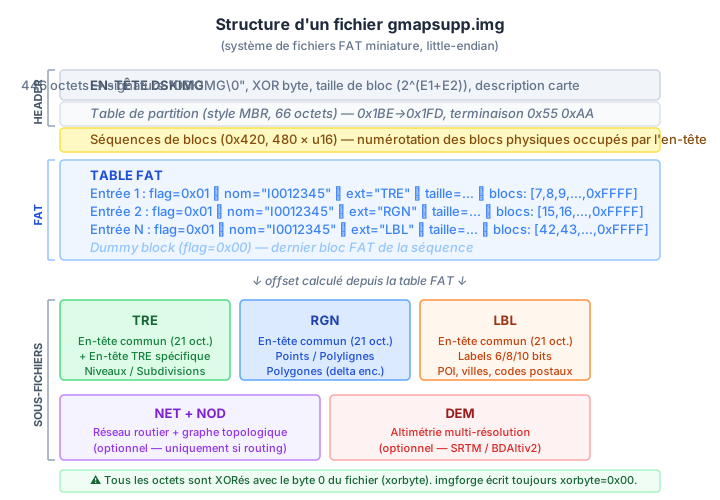
%%{init: {'theme': 'base', 'themeVariables': {'primaryColor': '#4caf50', 'lineColor': '#90a4ae'}}}%%
graph TB
    subgraph IMG ["gmapsupp.img (FAT filesystem)"]
        direction TB
        FAT["FAT Table\n(sub-file directory)"]
        subgraph Tuile1 ["Tile 003_012 (a geographic region)"]
            direction LR
            TRE1["TRE\n(spatial index)"]
            RGN1["RGN\n(geometries)"]
            LBL1["LBL\n(labels)"]
            NET1["NET\n(roads)"]
            NOD1["NOD\n(nodes)"]
            DEM1["DEM\n(elevation)"]
        end
        subgraph Tuile2 ["Tile 003_013"]
            direction LR
            TRE2["TRE"]
            RGN2["RGN"]
            LBL2["LBL"]
        end
        TDB["TDB\n(global metadata)"]
        TYP["TYP\n(symbology)"]
    end
    FAT --> Tuile1
    FAT --> Tuile2
    FAT --> TDB
    FAT --> TYP

    style IMG fill:#f5f5f5,stroke:#9e9e9e
    style FAT fill:#78909c,stroke:#546e7a,color:#fff
    style TRE1 fill:#4caf50,stroke:#2e7d32,color:#fff
    style RGN1 fill:#2196f3,stroke:#1565c0,color:#fff
    style LBL1 fill:#ff9800,stroke:#e65100,color:#fff
    style NET1 fill:#9c27b0,stroke:#6a1b9a,color:#fff
    style NOD1 fill:#9c27b0,stroke:#6a1b9a,color:#fff
    style DEM1 fill:#795548,stroke:#4e342e,color:#fff
    style TRE2 fill:#4caf50,stroke:#2e7d32,color:#fff
    style RGN2 fill:#2196f3,stroke:#1565c0,color:#fff
    style LBL2 fill:#ff9800,stroke:#e65100,color:#fff
    style TDB fill:#607d8b,stroke:#37474f,color:#fff
    style TYP fill:#607d8b,stroke:#37474f,color:#fff
XOR byte — obfuscation, not encryption
All bytes in the container are XORed with the xorbyte (byte 0 of the file) on read/write. Since the key is stored in the file itself, the operation is trivially reversible — this is obfuscation, not encryption. Community maps (imgforge, mkgmap) always write xorbyte = 0x00. Commercial Garmin maps sometimes use a non-zero value, but without providing real security at this level.
DSKIMG header
The header occupies the first 512 bytes and describes the "disk" geometry (block size, signatures, map metadata). Its structure intentionally resembles a DOS Master Boot Record.
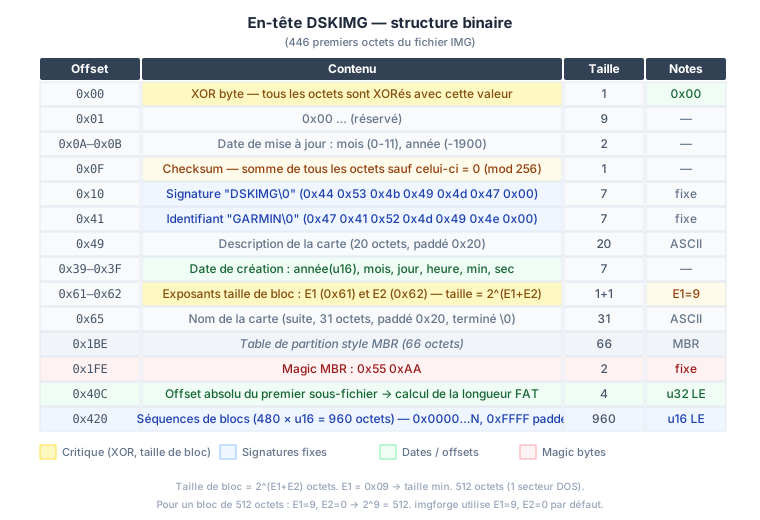
The block size 2^(E1+E2) is critical: it defines the granularity of all addresses in the FAT table. imgforge uses E1=9, E2=0 → 512-byte blocks by default. Larger blocks (1024, 2048 bytes) allow larger-capacity IMG files.
Sub-file format
Each sub-file (TRE, RGN, LBL, NET, NOD, DEM) begins with an identical 21-byte common header — defined in mkgmap CommonHeader.java and reproduced in imgforge/src/img/common_header.rs.
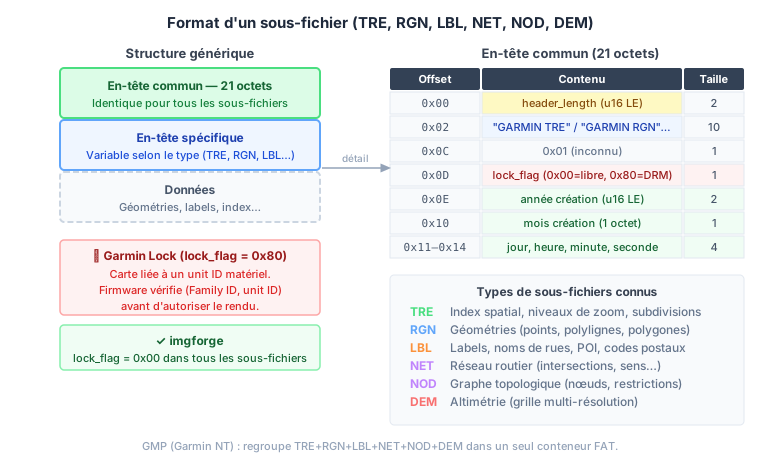
The lock_flag and the Garmin Lock system
This is where the real DRM protection of commercial Garmin maps (City Navigator, TOPO France...) resides, distinct from the container's XOR byte.
When lock_flag = 0x80, the Garmin firmware requires an unlock code linked to the device's hardware identifier (unit ID). The map is purchased for a specific device — at startup, the firmware checks the pair (map Family ID, GPS unit ID) before authorizing display. Without a valid code, the map appears in menus but remains invisible on screen. This is what MapInstall and myGarmin manage when purchasing paid maps.
For our maps (imgforge): lock_flag = 0x00 in all sub-files — unlocked by definition, consistent with the open nature of IGN BDTOPO data.
Garmin coordinates (map units)
The Garmin GPS uses its own coordinate system, not direct decimal degrees. Coordinates are encoded as signed 32-bit integers according to the formula:
For a map with 24-bit resolution (most detailed level):
| Resolution (bits) | Approximate precision | Usage |
|---|---|---|
| 24 | ~2 m | Maximum zoom, GPS detail |
| 23 | ~5 m | Intermediate level (7L header) |
| 22 | ~9 m | Neighborhood zoom |
| 21 | ~19 m | Intermediate level (7L header) |
| 20 | ~37 m | City zoom |
| 18 | ~150 m | Regional zoom |
| 16 | ~600 m | National zoom |
The levels in the Polish Map header (level0: "24", level1: "23"...) directly correspond to these bit values. imgforge uses the 7-level header 24/23/22/21/20/18/16 for all production scopes.
Subdivision: the basic rendering unit
The central concept of the IMG format is the subdivision (TRE/RGN subdivision). It is the elementary cell of spatial slicing — each tile contains a hierarchy of nested subdivisions.
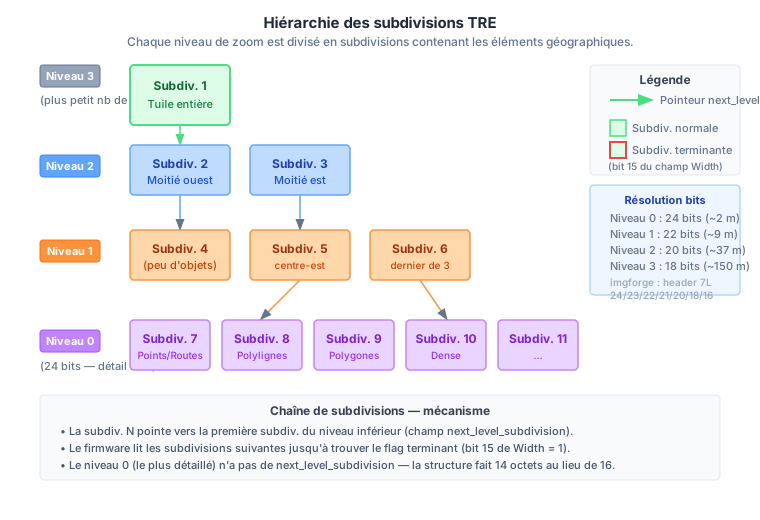
%%{init: {'theme': 'base'}}%%
graph TD
    Carte["Entire map\n(1 TRE file)"]
    Carte --> SD0["Level 0 (24 bits)\nSubdivisions of ~1°×1°\nmax 250 pts/element"]
    Carte --> SD1["Level 1 (22 bits)\nSubdivisions of ~2°×2°"]
    Carte --> SD2["Level 2 (20 bits)\nLarger subdivisions"]
    SD0 --> E1["Points (POI)\nPolylines (roads)\nPolygons (forests)"]
    SD1 --> E2["Points (cities)\nSimplified polylines\nSimplified polygons"]
Each subdivision is a rectangular area (bounding box + center) containing pointers to geographic elements in the RGN for a given zoom level. The Garmin firmware selects the subdivisions visible on screen and displays them — this is the "internal tiled" rendering engine.
Subdivision structure (16 bytes for non-leaf levels, 14 for level 0):
| Field | Size | Description |
|---|---|---|
rgn_data_ptr |
3 | Offset in the RGN file |
obj_types |
1 | Bitmask of present types (0x10=pts, 0x20=indexed pts, 0x40=polylines, 0x80=polygons) |
longitude_center |
3 | Center longitude (Garmin units) |
latitude_center |
3 | Center latitude |
width |
2 | Width + bit 15 = chain terminating flag |
height |
2 | Height (Garmin units) |
next_level_subdivision |
2 | Index of first subdivision at the lower level (absent at level 0) |
TRE — Spatial index
The TRE sub-file (Tree data) is the brain of a tile. It contains:
- The map header — bounding box, zoom levels, routing flag
- The subdivision table — the list of all subdivisions with their bounding box and offsets in the RGN
- The overview sections — for tiles participating in a multi-tile map
Common header (21 bytes)
  + TRE-specific header_length (188 bytes in standard mode)

Tile bounding box:
  max_lat  (24 bits, 3 bytes)
  max_lon  (24 bits, 3 bytes)
  min_lat  (24 bits, 3 bytes)
  min_lon  (24 bits, 3 bytes)

Zoom levels:
  levels_count (1 byte)       — number of levels
  Level0_bits  (1 byte)       — level 0 resolution (e.g.: 24)
  Level1_bits  (1 byte)       — level 1 resolution (e.g.: 23)
  ...

Section pointers:
  map_levels_offset / map_levels_size     (zoom levels)
  subdivisions_offset / subdivisions_size (subdivision list)
  polylines_defn_offset / ...             (type definitions)
  polygons_defn_offset / ...
  points_defn_offset / ...
Overview levels (TRE overview section)
For tiles that participate in a multi-tile map, the TRE also contains an overview section with data from wide zoom levels (levels 7-9 in the 7L+ header). This section allows the firmware to display simplified borders and roads before having loaded the detailed tiles.
History of the Alpha 100 wide-zoom bug
A critical bug (fixed in 7e68d62) hardcoded max_level=0 in the TRE overview section, making wide zoom levels invisible on the Alpha 100. The correct value must be max_level = levels_count - 1.
RGN — Geometries
The RGN sub-file (Region data) contains all geometries encoded in variable-width delta.
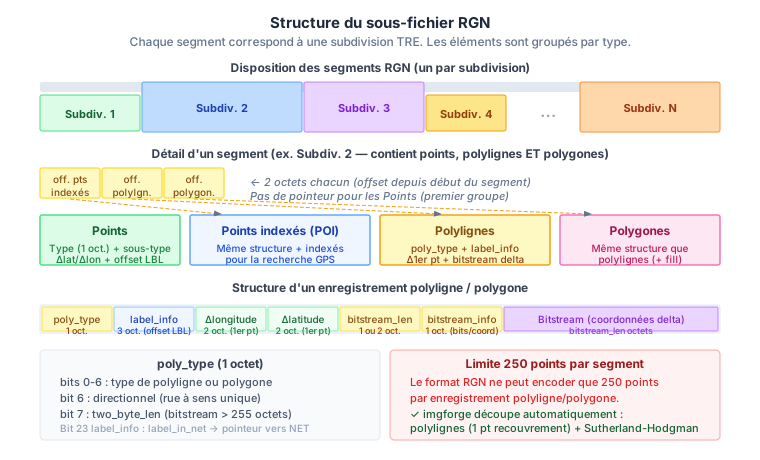
%%{init: {'theme': 'base'}}%%
flowchart LR
    RGN["RGN\nsub-file"] --> POI["Points / POI\n1-byte type + subtype\nAbsolute coordinates\nLabel (LBL offset)"]
    RGN --> PLY["Polylines\nType (1-2 bytes)\nEndLevel (4 bits)\nDelta encoding\nOptional label"]
    RGN --> PGN["Polygons\nType (1-2 bytes)\nDelta encoding\nOptional label"]
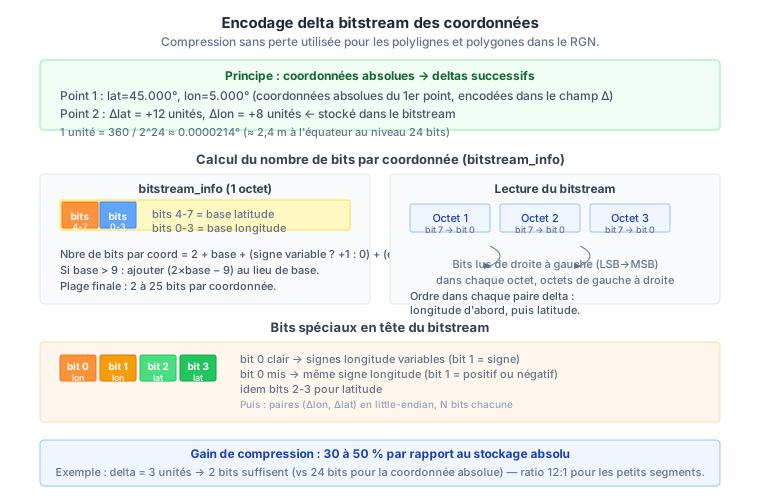
Delta bitstream encoding
Coordinates are not stored as absolute values but as successive differences (deltas). This reduces file sizes by 30 to 50%:
250-point limit
The RGN format imposes a limit of 250 points per polyline/polygon segment. imgforge automatically splits features exceeding this limit:
- Polylines: segmented with 1 overlap point at junctions
- Polygons: split by recursive Sutherland-Hodgman clipping
LBL — Labels
The LBL sub-file (Label data) contains all names (streets, cities, POIs...) in a compact format.
Three supported encodings
| Format | Encoding | Bits per character | imgforge option |
|---|---|---|---|
| Format 6 | Reduced 6-bit ASCII | 6 bits | default |
| Format 9 | Windows code page (CP1252, CP1250...) | 8 bits | --latin1 |
| Format 10 | UTF-8 | variable | --unicode |
Format 6 is the most compact but only supports characters A-Z, 0-9 and space. For French maps, Format 9 with CP1252 is recommended: it covers all French accented characters while remaining compact.
Labels are stored end-to-end with a 0x00 byte as separator. Polylines and polygons reference their label by an offset in this section (multiplied by the label_multiplier if > 0).
NET and NOD — Routing
The NET and NOD sub-files implement the road topology for turn-by-turn navigation.
%%{init: {'theme': 'base', 'themeVariables': {'primaryColor': '#4caf50', 'lineColor': '#90a4ae'}}}%%
flowchart TD
    Routes["Routable features\n(TRONCON_DE_ROUTE\nwith RouteParam)"]
    Routes --> NET["NET\n(Network data)\n\nRoad table:\n- Road type\n- Speed limit\n- Direction of travel\n- Restrictions (one-way, toll...)\n- Offset to NOD"]
    Routes --> NOD["NOD\n(Node data)\n\nTopological graph:\n- Intersection nodes\n- Turn restrictions\n- Turn-by-turn data"]
    NET & NOD --> GPS["Route calculation\non the GPS"]
Experimental routing in imgforge
The road network generated by imgforge is indicative only. The NET/NOD graph is built from BDTOPO attributes (VITESSE_MOYENNE_VL, ACCES_VL, direction of travel) but coverage of complex restrictions (roundabouts, regulated access) is partial.
DEM — Elevation
The DEM sub-file stores elevation data used for relief shading (hillshading) and altitude profiles on the GPS.
DEM header:
  bounding_box   (lat/lon min/max)
  zoom_levels    (number of levels)
  base_bits      (base precision)

For each zoom level:
  Section-header (60 bytes):
    distance     (spacing between points, in map units)
    rows × cols  (grid dimensions)
    data_offset  (offset +32 in the section-header)
    data_offset2 (offset +36)
  elevations[]   (delta-encoded, signed, in meters)
imgforge reads HGT files (SRTM NASA, ⅓ arc-second format) and ASC files (ESRI ASCII Grid — IGN BDAltiv2), reprojects them to WGS84 if necessary, and generates the multi-resolution DEM grid.
The --dem-dists parameter controls the spacing between elevation points per zoom level. A larger spacing reduces file size but degrades relief precision at low zoom.
DEM bug in GmpWriter
The data_offset/data_offset2 offsets in DEM section-headers are at +32 and +36 — not +20 and +24 as initially coded. The error triggered an allocation of ~1290 DEM descriptors at Alpha 100 boot. Fixed in relocate_dem.
TDB — Global metadata
The TDB sub-file (Topo Data Block) is unique in a gmapsupp.img. It contains the metadata for the entire map, used by PC software (BaseCamp, MapInstall):
Family ID     (u16)  — unique map family identifier
Product ID    (u16)  — product identifier
Family name         — "BDTOPO France"
Series name         — "IGN BDTOPO 2026"
Country, Region     — for BaseCamp catalog
Bounding boxes      — list of tiles with their extent
Copyright           — legal message
TYP — Custom symbology
The TYP file is not tied to a specific tile: it is a dictionary of symbols (colors, fill patterns, icons) that replaces the firmware's default symbology for the Garmin types used in the map.
Section [_id]      — family identifier (must match TDB Family ID)
Section [Type0xNN] — polyline type definition
  String1=Main road
  Color=0xRRGGBB
  Width=3
Section [Type0xNN P]  — polygon type definition
Section [Type0xNN E]  — POI type definition
CP1252 encoding
The TYP file for this project (I2023100.typ) is generated by TYPViewer in Windows-1252. imgforge typ compile --encoding cp1252 or automatic detection (auto) handle this file correctly.
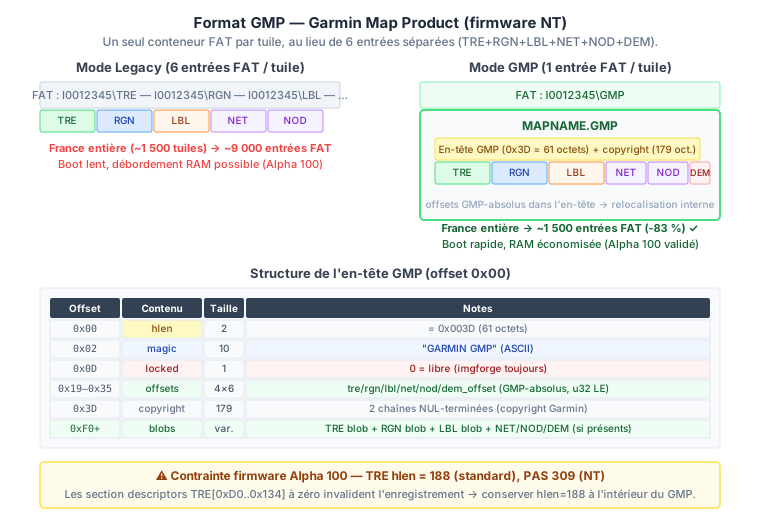
GMP — Consolidated Garmin NT format
The GMP format (Garmin Map Product) is a modern variant that groups a tile's sub-files into a single FAT file — eliminating 83% of FAT entries for a full France map.
Implementation pitfalls — Alpha 100 firmware
The GmpWriter implementation required 5 hardware test cycles (GC1-GC5) to identify undocumented Alpha 100 firmware constraints:
| Pitfall | Symptom on Alpha 100 | Cause | Fix adopted |
|---|---|---|---|
NT extension of TRE (hlen=309) |
Invisible tile | TRE section descriptors[0xD0..0x134] at zero invalidate the record | Keep hlen=188 (standard TRE) inside the GMP |
tre10_rec_size = 0 |
Firmware crash | count = size / rec_size with rec_size=0 → division by zero |
Included in the hlen=188 fix |
relocate_dem — wrong positions |
GMP not recognized with DEM | data_offset at +32/+36 but code patched +20/+24 → firmware allocates ~1290 descriptors |
Correct base+20/24 → base+32/36 in relocate_dem |
Validated in production on Alpha 100
--packaging gmp has been functional in production since April 2026, validated on Alpha 100 firmware
with a complete IGN BD TOPO D038 build (BDAltiv2 altimetry data included).
From Polish Map (.mp) to IMG file — the imgforge pipeline
The Polish Map format (.mp) is the intermediate text format between mpforge and imgforge. It describes features with their Garmin type, WGS84 coordinates, and metadata:
[IMG ID]
...
[POLYLINE]
Type=0x05          ; Garmin type (national road)
EndLevel=2         ; Disappears at zoom level 2
Label=RN7
RouteParam=3,0,0,0,0,0,0
Data0=(45.123,5.456),(45.127,5.461),(45.130,5.468)
Data2=(45.123,5.456),(45.130,5.468)      ; Simplified geometry level 2
[END]
imgforge reads these files and performs the following transformations:
%%{init: {'theme': 'base', 'themeVariables': {'primaryColor': '#4caf50', 'lineColor': '#90a4ae'}}}%%
flowchart TD
    MP[".mp files\n(Polish Map)"]
    MP --> PARSE["1. Parsing\nWGS84 coordinates\nGarmin types\nDataN= multi-geometries"]
    PARSE --> COORD["2. Coordinate conversion\nWGS84 → Garmin units\n(24-bit integers)"]
    COORD --> SPLIT["3. RGN splitter\nSplit > 250 pts\nSutherland-Hodgman"]
    SPLIT --> FILT["4. Optional filters\nDouglas-Peucker (--reduce-point-density)\nSmall polygons (--min-size-polygon)\nLine merging (--merge-lines)"]
    FILT --> SUBDIV["5. Subdivision generation\nBounding box computation\nLevel assignment"]
    SUBDIV --> ENC["6. Binary encoding\nVariable-width delta\nCP1252/UTF-8 labels"]
    ENC --> TRE_OUT["TRE\n(spatial index)"]
    ENC --> RGN_OUT["RGN\n(geometries)"]
    ENC --> LBL_OUT["LBL\n(labels)"]
    ENC --> NET_OUT["NET+NOD\n(routing)"]
    ENC --> DEM_OUT["DEM\n(elevation)"]

    style MP fill:#4caf50,stroke:#2e7d32,color:#fff
    style TRE_OUT fill:#4caf50,stroke:#2e7d32,color:#fff
    style RGN_OUT fill:#2196f3,stroke:#1565c0,color:#fff
    style LBL_OUT fill:#ff9800,stroke:#e65100,color:#fff
    style NET_OUT fill:#9c27b0,stroke:#6a1b9a,color:#fff
    style DEM_OUT fill:#795548,stroke:#4e342e,color:#fff
Format limits
| Limit | Value | Impact |
|---|---|---|
| Points per polyline/polygon segment | 250 | imgforge splits automatically |
| Zoom levels | 10 (max) | Standard 7L Polish Map header + 3 overview |
| Sub-files per tile | ≤ 6 (legacy) or 1 (gmp) |
NET/NOD absent without routing, DEM absent without --dem |
| Encoded label size | ~255 bytes | Very long labels truncated |
| Coordinate precision | 24 bits (~2 m) | Sufficient for road/outdoor mapping |
| gmapsupp FAT entries | Firmware-dependent | Alpha 100: RAM ceiling at boot → prefer cell_size ≥ 0.30° or GMP mode |
Going further
| Resource | Local location | Content |
|---|---|---|
| imgformat-0.5 specification | tmp/imgdecode-1.1/imgformat-0.5.pdf |
TRE, RGN, LBL, NET structures (John Mechalas, 2005) |
| imgdecode-1.1 | tmp/imgdecode-1.1/ |
Reference C++ decompiler |
| mkgmap r4924 | tmp/mkgmap/ |
Reference Java implementation |
| imgforge | tools/imgforge/src/img/ |
Rust implementation (this project) |
| PDF reference document | site/assets/resources/garmin-img-format-reference-fr.pdf |
This project, printable version |
Comments
Comments are managed by Comentario,
self-hosted at comentario.allfabox.fr. Posting a comment may set a session cookie.